


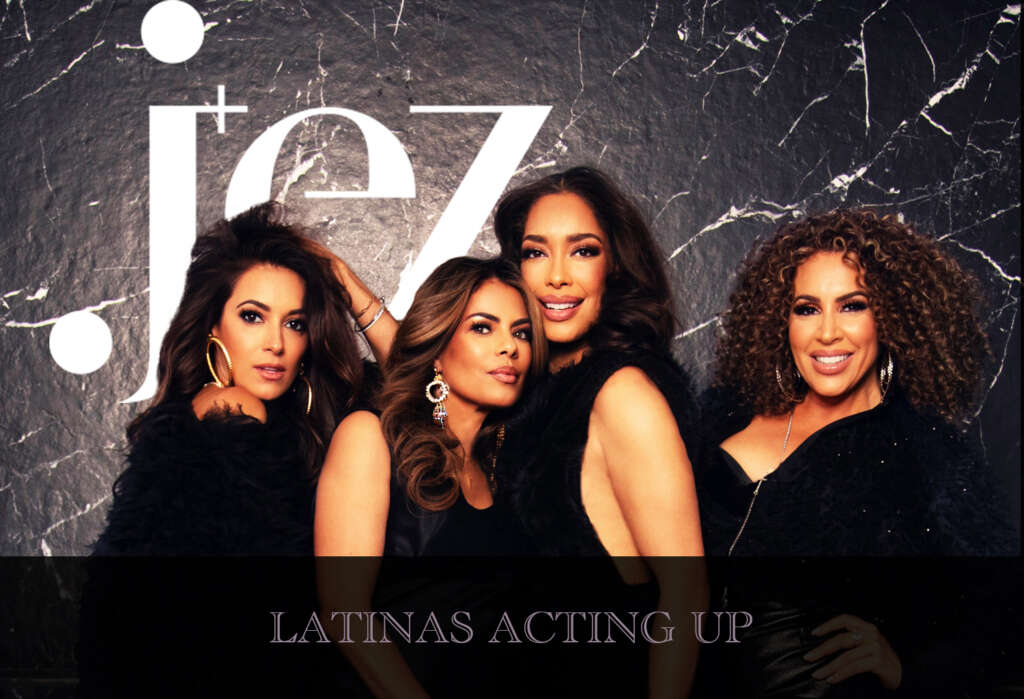
Photo by Ezequiel De La Rosa hair by @_thehairsaint_ Makeup by @jocelyn_biga Style by @muneca_2679
Latinas Acting Up!
JEZ Magazine recently had the opportunity to connect with Latinas Acting Up, a formidable group of 5 SAG-AFTRA Latina women, Actors hailing from a variety of backgrounds, bonded over a shared undertaking. Advocating for authentic storytelling and creating new inroads for Latina representation both in front of the camera and behind the camera, their combined credits cover hundreds of productions shown on a variety of 13 networks for movies, television, and streaming services, as well as the theater.
Supporting at least 12 charities from LA’s Children’s Hospital to Justice for Migrant Women and PETA, these resilient Poderistas have taken charge, making their voices heard while initiating positive transformation across the industry. The term Poderistas, broadly refers to Latinas who actively build and utilize their own power along with the collective power of the Latina community to define and implement constructive change.
Their notable recognition in the industry spans the scope of prestigious categories from the Latino Spirit Award for Advocacy and Entertainment, the Screen Actors Guild Award, and the Alma Award, to the Imagen Award and the Marian A. Spencer Award just to cite a few. It would appear their castings in such an extensive array of programming proves Actors of Latino descent need no help securing plum roles in Hollywood, but that’s not the case.
Behind the scenes truth belies fact stirring the need for positive engagement to draw attention to their mission. Currently, LAU is in the beginning stages of outreach into key areas across the US offering support to Latina television, film and stage professionals seeking jobs who may otherwise be sidelined. They can also be found on the front line of rallies hinging on issues particular to studio life such as equitable pay for women in tv/film, erasing bias against diversity in tv/film, pay rate stability from job to job, health care benefits and childcare.
It’s clearly evident that siloed thinking has contributed to stereotypical bias when viewed through the closeted, monolithic culture in Hollywood, controlling a business with much allure and skewed opportunity for people of color and diverse ethnicities. It’s a contributing factor as to why Latinas Acting Up is working hard to tip the scales in favor of a better future with the creation of their platform. Most importantly, their outreach aspires to promote the empowerment of others through joyful leadership and a resolute approach serving them well through its expansion.
We’re delighted that Co-founders Diana Maria Riva, and Lisa Vidal, together with Gina Torres, Angelique Cabral and Constance Marie agreed to share their story with JEZ Magazine. Exuding palpable energy, their resilience unwavering, their mission to champion change a story to be told. Latinas Acting Up is steadfastly laboring on behalf of their community infusing love, strength and courage into every action they take. All we can say is stay tuned!
(We have included Bios in Brieffor each of our guests with a link to Latinas Acting Up.) To learn more please go to: www.latinasactingup.com
IG: @latinasactingup
E-MAIL: info@latinasactingup.com
Latinas Acting Up Mission Statement: We are a group of creatives united to amplify voices, foster sisterhood, and transform the entertainment and arts industries through advocacy and mentorship, while generating greater visibility and the representation of Latinas in every aspect of film and theater production.
JEZ Magazine is pleased to introduce:
Diana Maria Riva

Photo by Ezequiel De La Rosa
An award-winning actress with a career spanning more than two decades, Diana Maria Riva is known for standout roles in Dead to Me, Glamorous, The Gordita Chronicles, and McFarland USA. Her performance opposite Christina Applegate and Linda Cardellini in Dead to Me earned a Screen Actors Guild Award nomination and won the Imagen Award for Best Supporting Actress and multiple nominations for excellence in comedy and ensemble performance, solidifying her as a powerful presence on screen. Other standout roles include Disney’s Noelle, and critically acclaimed titles like Short Term 12, Love and Mercy, and Our Family Wedding alongside talent such as Kevin Costner, Shirley McClaine, America Ferrera, Brie Larson and John Cusack. On television, she has appeared in celebrated series including The West Wing, Man with a Plan, Telenovela (with Eva Longoria), and The Good Guys (with Bradley Whitford and Colin Hanks. Beyond the screen, Riva is a committed advocate for equity in entertainment and is co-founder of Latinas Acting Up alongside actor Lisa Vidal. Born and raised in Cincinnati with roots in the Dominican Republic, Riva holds an MFA in Theater from the University of Cincinnati. Diana is the proud mother of 2 and resides in Los Angeles.
Lisa Vidal
Photo by Ezequiel De La Rosa
Award winning actress Lisa Vidal is no newcomer to the challenging multi-layered roles she has successfully portrayed. Most recently, Lisa wrapped work on the feature film Righteous Thieves, where she was lead opposite of Jaina Lee Ortiz. Previously, she has been a success in and recognized for her celebrated roles in Boston Legal, CSI Miami, The Division, ER, Third Watch, Southland, and starred opposite Gabrielle Union on BET’s most successful series Being Mary Jane. A seasoned actress of Puerto Rican descent, New York City native Lisa Vidal began acting in Repertory Theater at age 14 and made her T.V. debut on the PBS series “Oye Willie” – jump-starting a long and varied acting career. Vidal’s impressive list of roles included memorable characters in critically acclaimed shows such as The Cosby Show and Miami Vice, New York Undercover, the Steven Spielberg police drama High Incident, and The Brian Benben Show, committed to taking roles that reflected the diversity of the Latino community. Lisa’s feature film credits include Night and the City, We’re Not Married? Dark Mirror, Victor, and the critically acclaimed I Like it Like That. When not on screen, Lisa dedicates her time to impactful organizations such as Cure Addiction Now where she serves on the board and is the co-founder of Latinas Acting Up alongside actor Diana Maria Riva. Lisa currently resides with her family in Los Angeles, California.
Gina Torres
Photo by Ezequiel De La Rosa
Recognized as the first Afro-Latina woman to create, star in, and produce a TV series, “Pearson”, released in 2019, Gina Torres has spent thirty years establishing herself as a force to be reckoned with in television, film and on stage. From the USA Network’s hit series “Suits” to Fox’s “9-1-1”, Lone Star”, “Cleopatra”, “The Shield” and “Pushing Daisies”, Torres has amassed an impressive portfolio along the way. Racking up appearances in “The Catch”, “Hannibal “, “Revenge”, and the “Shield”, Torres has worked with Fox, Disney, Netflix, and Prime appearing in top rated entertainment series and films including, “Law and Order”, “The Vampire Diaries”, “Femme Nikita”, and “Xena the Warrior Princess”, acquiring distinguished recognition and several awards including the Alma Award and the Imagen Award to name a few. Torres’s recent stage role in a modern day remake of Hamlet, starring as Gertrude, Directed by Robert O’Hara, brought her the opportunity to delve into her love of Hitchcockian mastery in storytelling as inspiration. In addition to her charitable endeavors, Torres is a founding board member of Latinas Acting Up and resides in LA.
Constance Marie
PHOTO BY Russell Beyer
Constance is best known for her beloved portrayal of wife ‘Angie Lopez,’ in the ABC comedy series, “George Lopez.” She starred in the Amazon Latinx romantic series, “With Love,” and the rotoscope dramedy, “Undone.” Constance will next be seen in the upcoming season of the Netflix hit comedy series, “A Man on the Inside.” She stars opposite Ted Danson. Also “A Murder in Montecito,” a new Sonoro Media murder mystery podcast in which Constance voices a lead character opposite Gina Torres. Recently appearing in “Doctor Odyssey” and “9-1-1.” She previously starred in the hit Freeform series, “Switched at Birth,” and voiced a character on Disney’s animated series “Elena of Avalor,” the first to feature a Latina princess. For the big screen, Constance portrayed Tejano music legend Selena Quintanilla’s mother ‘Marcella,’ in the blockbuster film, “Selena.” She is an advocate for PETA and the East Los Angeles Women’s Center and a founding board member of Latinas Acting Up
Angelique Cabral
Photo by Ezequiel De La Rosa
Angelique Cabral is an actress, producer and activist known for standout roles in Life in Pieces, Enlisted, Disney’s Wish, where she voiced Queen Amaya in a history-making animated film that introduced Disney’s first Latina Queen, and most recently Long Story Short on Netflix, and The Neighborhood on CBS.
Her wide-ranging TV and film credits include Big Sky, Maggie, With Love, and For Worse, which premiered at the 2025 SXSW Film Festival.
A third-generation Mexican American, Angelique is committed to service and representation. She’s an ambassador for This Is About Humanity, a vocal advocate for migrant justice and voter engagement, and a founding board member of Latinas Acting Up. Off-screen, she’s a mom of two, a theater fellow, and a passionate force using her platform to uplift and empower Latina creatives.
The Conversation
JEZ: What was the catalyst for starting this group? Was there a specific event, a crushing experience or failure? A calling?
RIVA: I was sitting on the couch after picketing with the WGA (Writers Guild of America) one day during the 2023 strike when Sag-Aftra joined the strike, which you’ll recall was about fighting for equitable pay and sustainable living wages, as well as securing contract provisions protecting our images since the advent of AI. But we had a history of not being united within our union and there was much at stake if we didn’t come together and see this movement to the finish line. I felt I needed to do my part as a Sag-Aftra member. So I thought of creating a themed group, giving it the name of Latinas Acting Up for picketing, to bring our collective voices together for staying power and greater impact. I called Lisa Vidal, we’d been friends for some time already, to see what she thought about organizing this group with me to help amplify Latina voices in the tv/film industry. She agreed and we put our heads together, organized our first official picket, and launched.
Photo by Ezequiel De La Rosa
JEZ: So what came next?
RIVA: We committed to getting right on the front lines to see what kind of impact we could make for our Union, and from day one Latinas Acting Up took off. We started with a mass email to all our Latina peers in town telling everyone where to meet and why we needed to come together. We had t-shirts and signs made and we really had no idea who would show up. It was incredible. We expected about 30 women and instead around 80 women gathered for that first event, and we looked around wondering who all these women were. We were totally surprised to see so many Latinas from every stage of their careers, had heard about our group and showed up in droves.
VIDAL: We were in shock! We realized right then it was a niche needing to be filled. The launch of Latinas Acting Up was the birth of an amazing platform. From that moment we knew we’d have to get organized, and it became more evident as we held a number of weekly events. Gina, Constance, and Angelique showed up for every meeting, and we knew they had to become our board members. Together, we’re really making a difference.
RIVA: We were out with flags, and signs, t-shirts every week for months and attendance exploded. We had Latinas representing every origin of our culture coming out. And we made the front pages of so many periodicals and news agencies in the region from the LA Times, Vanity Fair, to Deadline, The Hollywood Reporter, Latina, and Ms. magazine. We couldn’t believe how many young women were joining us. There was an overall need and desire for community we all seemed to be looking for, which is difficult to find in the entertainment business.
Photo by Ezequiel De La Rosa
JEZ: What is the essence of the Latinas Acting Up platform?
RIVA: At our core, Latinas Acting Up is a platform of support and reciprocity. We are Latinas in entertainment, theater, and all media arts from in front of and behind the scenes, who have come together to raise visibility and increase representation of Latinas in the industry. We’re a sisterhood empowering and uplifting each other, while offering mentorship and a genuine community. The platform is positive and purposeful, but we are also business minded with workshops, labs and much more. We are committed to developing a pipeline of amplification of each other’s works and creating leaders in the industry.
JEZ: Do you have a plan in place to encourage the creation of partnerships between the Hollywood studios and Latino production companies to create more diverse content?
VIDAL: Oh yes. We have several strategic plans in the works to network and connect with studios and casting directors to change the narrative and create more opportunities for Latinas in the entertainment industry. We have a platform for talent now and it will give us the power to be our own bosses. The big picture is to eventually create, produce, cast and direct our own opportunities.
JEZ: According to the Pew Research Center, today, the Hispanic/Latino (of any race) population consists of 62.5 million people which is roughly 19.1% of the US population, and includes a variety of origins from 17 countries, wouldn’t it make sense to have programming reflecting the wealth of opportunities generated from their stories?
MARIE: Absolutely, it would. Latinos have made so many contributions to the Entertainment Industry. Latinos were represented in the 50’s and 60’s with DESILU Productions founded by Desi Arnaz and Lucille Ball. It was a cultural phenomenon, one of the highest rated programs of that era starring Desi Arnaz as Rickie Ricardo, and Lucile Ball as Lucy Ricardo. Desi invented the sitcom multi camera format that we still use today. Two of the most successful franchises, “Mission Impossible”, and “Star Trek”, were greenlit by DESILU Studios. But even with all those accomplishments, the lack of representation persists. The diversity of representation is very narrow. We can’t all be from the same neighborhood and economic backgrounds. Where is the Studio Head role? Only 5% of Latina’s are cast in lead roles. As creatives, we’re maintaining momentum at 5% when we KNOW we are at 19% across the board which is the reason we are motivated.
TORRES: Behind the scenes Arnaz was a true visionary who revolutionized the industry by creating the three camera system. It’s how the vast majority of sitcoms are still shot today. In front of the camera, the country fell in love with him as a perplexed husband, a kind friend, a doting father, and a business owner boasting a thick Cuban accent. He proved that the country would not just accept a Latino into their homes, but love and understand him. And yet, it took 20 years before we saw it accepted again, with Chico and the Man, and another 25 years after that to have the George Lopez Show. So to your earlier point, it is a point of great frustration to feel like we continue to clear hurdles of acceptance, overperform in terms of talent in front of and behind the camera, and the ability to generate financial value (it has been proven that diversity is lucrative), and still be marginalized.
VIDAL: It’s important for us to be intentional and aware of the stories we are telling about ourselves, and the stories others are telling about us. We are much more than negative stereotypes, Latinos have contributed wonderful things to this country and in the world, and those are the stories that need to be focused on and shared for all to understand. Doing so will help give the world the correct impression of Latinos, their overall contributions, and why a seat at the table is much deserved. LAU is taking action to do what we can to correct and change the narrative that has been perpetually used to stereotype our community. When we work together and take action together, we are stronger and more powerful. We believe that contribution will uplift not only our community, but relationships across the board regarding diversity.
CABRAL: I completely agree. As a Latina actor I recognize I have been fortunate in my career to go against the stereotype and play a number of successful Latinas, but this is not the norm. We’re frequently typecast into narrow, stereotypical characters, which is incredibly frustrating, especially when we’re all working hard to grow in our craft. We want to be portrayed as winning, not always struggling. We’re fully capable and want to take on a wide range of roles, featured in stories of successful people leading full lives. Latinos are so much more than how we get pigeonholed.
Photo by Ezequiel De La Rosa
JEZ: Understanding the diversity of cultures Latinas Acting Up is representing is important. We often hear the term Hispanic. Is that a politically correct term?
TORRES: Hispanic refers to having Spanish ancestry. Latino refers to Latin American ancestry. Many of us are of mixed ancestry, and every generation seeks to improve how we define ourselves. The only label Latinas Acting Up is focused on is that of HUMAN. While we celebrate the beauty of a common language, we also revel in the richness of our diversity. And at the end of the day, we all fight for our families, and our dignity, dreaming big, while working hard and loving harder. And we exist and excel in all stratas of society. What’s more universal than that?
VIDAL: Culture should bring us together, but our work shouldn’t be defined through our culture. We just want to be cast as women living life, doing life, and enjoying life just like any other woman.
JEZ: So what’s the process to find work? And we talked a little bit about pay scales earlier. Is there an established rate of pay for the different industry outlets?
RIVA: We audition and submit our tapes like anyone would submit their resume for a job. It’s a business of continuous “reapplying”. When it comes to pay, there are the union rates that apply to different tv and film contracts, but it’s always some level of negotiation. Finding work is a challenge. Getting paid what you’re worth is a greater challenge. The statistics show that, on average Latinas gets paid .58 cents to the $1.00 that a white, non-Hispanic male makes. For women of color, there’s always been this inequity. This is an area of education and mentorship we bring to Latinas Acting Up. It’s important that we educate ourselves on the pay disparities in our industry.
VIDAL: Owning our own power as Latinas helps us take control of the outcome. It creates a new spin on how we create and why. The influence and example it gives our younger generations is invaluable.
CABRAL: As creatives, we want and need to work just like everyone else. We’re passionate about our work. But we never know how long a job will last. And when a job does come along, we’re told this is the budget, that’s it, the salary is capped, but someone on that same project could be making more. It’s common to end up taking a job that is paying much less than the job we had before. It really is frustrating.
TORRES: Actors want to act. Artists want to create. And we also want to feed our families and make a living. Once we step away from a job, it’s natural to assume that if you did a good job and added to the value and success of that job, that it would be reflected in comparable offers and salaries. That’s not necessarily the case. There are many reasons for this. One is a lack of roles. Which means less opportunities to advance. Our goal is simple. To help create more opportunities and more experiences within our community, by showcasing our talent, thereby ensuring that our talent pool continues to grow and be nurtured.
VIDAL: Respect for our quotes and salaries that we have built after years of hard work and recognition of our craft and impact is of utmost importance and sends the message that what we do is valuable and is not being measured by the color of our skin.
MARIE: Our passion for our craft is very deep, and Studios often use that fact against us. We work for the love of the art, for the love of the craft, and for touching hearts, and minds. We know maintaining a presence in this industry is so important not just for us, but for future generations. Not only for younger Latino actors but for our community as a whole, a community that needs to see themselves as part of the positive fabric of society. Oftentimes, we choose to maintain the forward motion and get the positive representation out into the world and when we are low balled financially by Studios, we’re forced to settle. Also, factor in that we are mothers and providers as well as performers, so we still have to keep working to make money. It’s hard to say no because the bills need to be paid.
CABRAL: We didn’t even get to talk about what it’s like to be raising kids and having to be on set to work, sometimes on a location far from home, and how hard it is to manage daycare. And healthcare insurance can change from project to project. It’s not what you think it is and it’s another issue we’re trying to change.
JEZ: Surprised to hear this. We’ve been under the impression that it’s covered job to job and childcare can be situated on set.
CABRAL: There’s no childcare on set. We have to arrange childcare to be able to work and some projects take us away for extended periods of time. On certain projects it can be negotiated into a contract but it’s usually not available. And our jobs are never nine to five. 12-16 hour shoot days can be normal on a job.
JEZ: No wonder you’re all acting up. What’s the most important assessment about Latinas Acting Up that you’d like to leave with our readers?
RIVA: On the picket line, we were told we were too happy and joyous with our dancing and endless energy. We’d like everyone to know this isn’t a grievance committee. When you move through the frustration you arrive at a place of resolve. And we are resolved to make change with the impact of our collective voices. And we hope that impact will grow within the Latino community as well. The more of us we know, the more we grow.
VIDAL: No one gets the chance to tell us how to picket OR define who we are.
MARIE: The only way we survive as long as each of us has in this industry is to never let go of our joy. We carry it with us in all that we do.
VIDAL: Resilience is our mantra!
CABRAL: Our mission comes from a place of positive empowerment which is unshakeable.
TORRES: When we stand together in joy and resolve, people listen! With what’s happening in the world today, we need to stand tall. And that’s what Latinas Acting Up is all about.
Photo by Ezequiel De La Rosa
Contributor Denise Pereau

1 Comment
Cindy611
https://shorturl.fm/9mY3S
Comments are closed.